How Crosstalk works
Crosstalk does one thing: it makes supportive calls happen. You pick a time that works for you. When that time comes, the Crosstalk app calls you, and it calls other members who picked the same time. Answer, and you're guaranteed to speak with a supportive peer. No dialing, no phone tag, no hurt feelings.
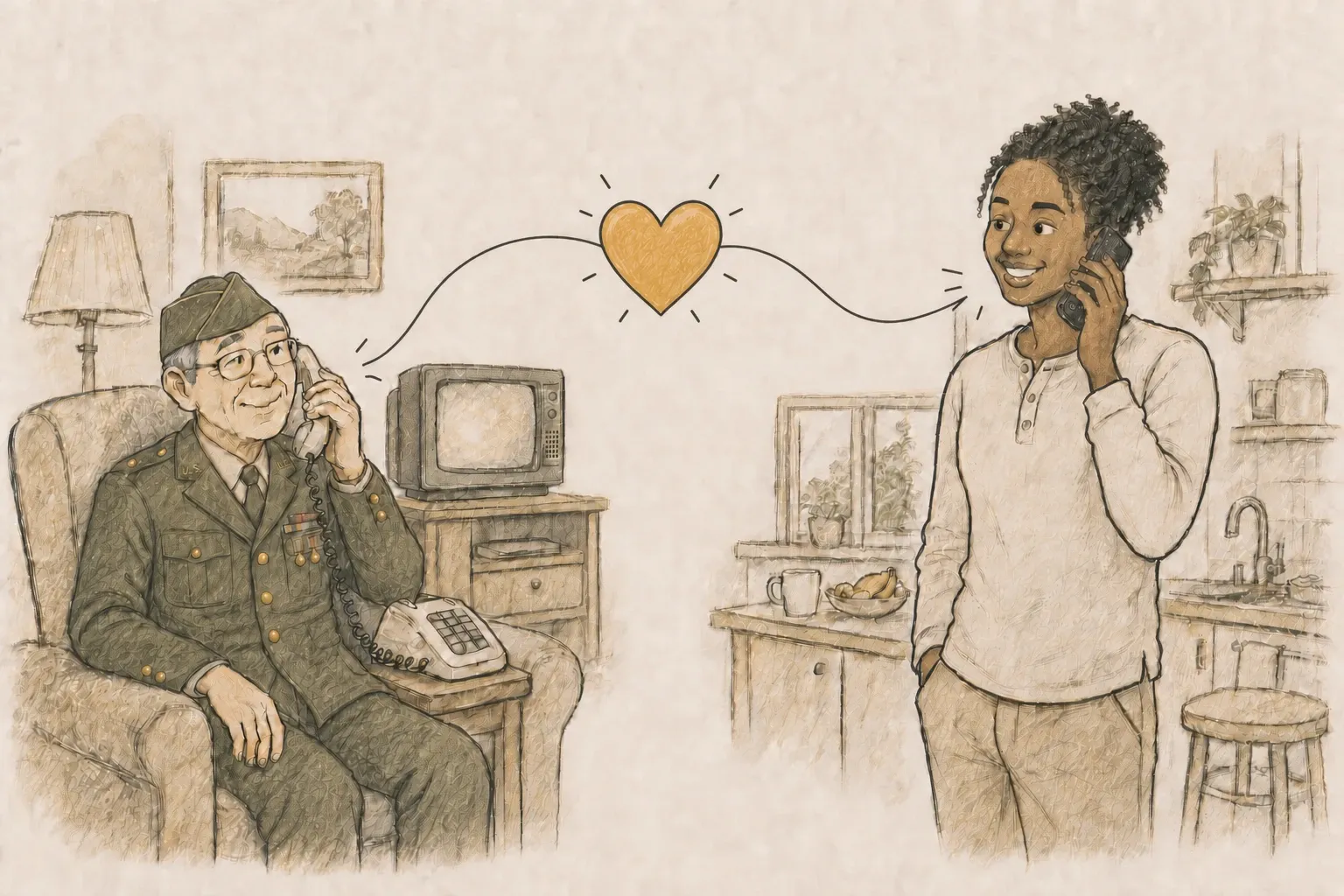
What using it actually looks like
7:00 p.m.
Crosstalk calls you
Say you choose 7 p.m., because evenings are when the house gets quiet and the day starts to feel heavy. At 7, your phone rings. Most members answer in the Crosstalk app, and a call can be video if you both want it. If you don't have the app, or an app call doesn't go through, Crosstalk calls your phone the regular way.
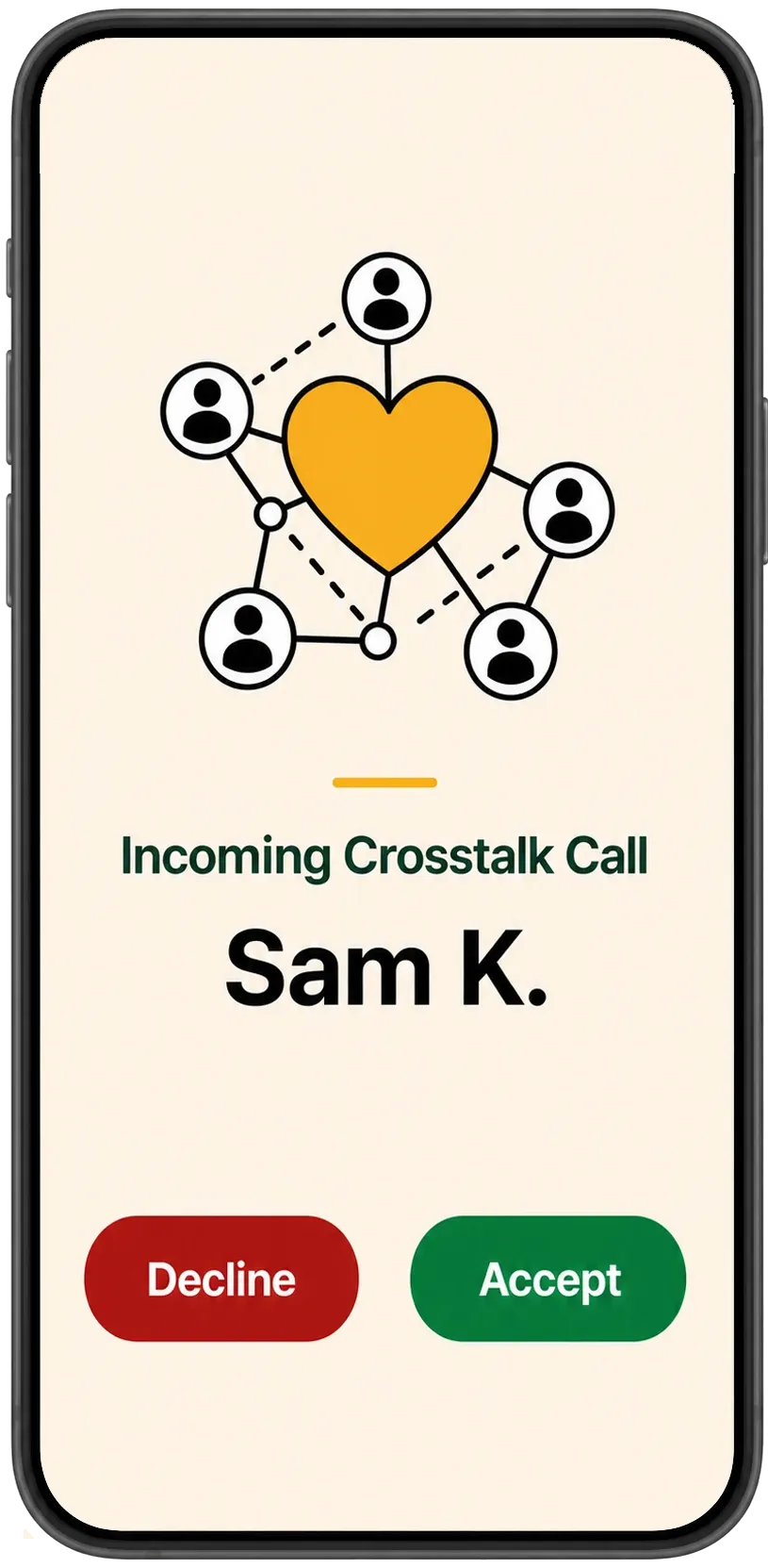
A few seconds later
You answer, you're talking
You're connected one-on-one with another member who also chose 7 p.m. and also answered. You're each introduced by the name or nickname you chose when you joined. Neither of you sees the other's phone number. Neither of you had to dial, decide whom to call, or wonder whether you'd be interrupting. You just talk, the way people do. And the match isn't random: Crosstalk favors people who share one of your groups, leans on the wisdom of sponsorship by connecting newcomers with people further along, and learns from your feedback who you click with.
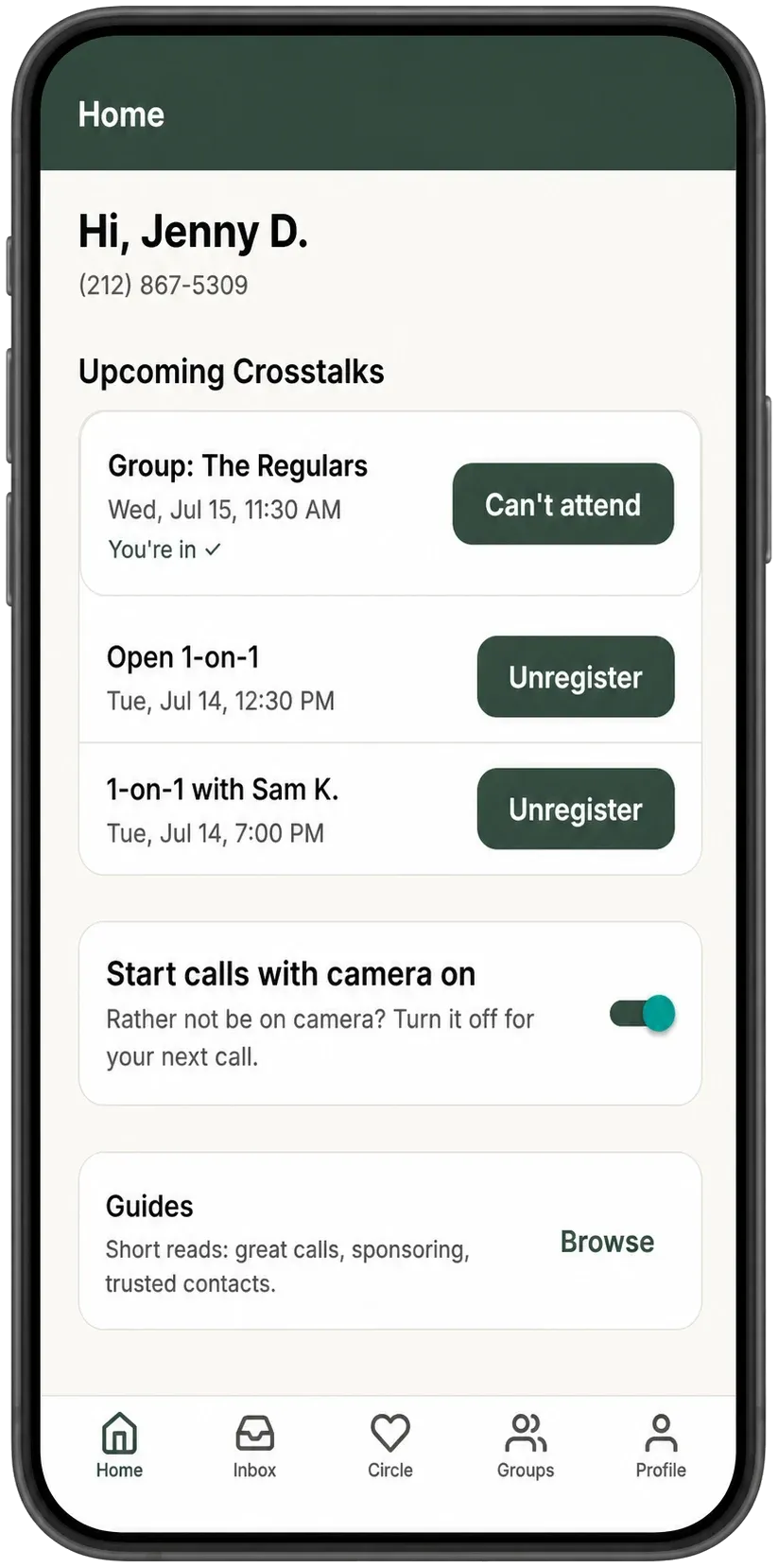
Tomorrow, and after
The schedule is yours
Tomorrow at 7 again, a different time on weekends, or only the days you choose. Some conversations are five minutes. Some go long. Over time, familiar voices come back, and if you both choose, you can stay connected on purpose. When you want to schedule a call together, Crosstalk can suggest times when you're both free. The calls are the front door. What they build is the point: people who know your voice and notice when it's missing.
Both directions
Answering is an act of service
Every time you answer, someone else's call got answered. Being on the other end of the line is you showing up for someone too. Some members make that their whole reason for being here: people with years of recovery stay available so a newcomer always reaches someone, and younger volunteers keep a regular call with an isolated older adult or disabled member. They say the best way to help yourself is to help others. If you'd like to be one of them, reach out.
The rules of every call
- You choose your name. Other members hear the name or nickname you pick; in recovery, many people go by a first name and last initial. Your phone number is never shown to the people you talk with; calls are bridged through our system so neither person sees the other's number unless you choose to share it.
- We don't record conversations. And your information is not for sale, to anyone, ever. There are no ads.
- You're always in control. Anyone can block anyone, instantly, no questions asked. Texting STOP ends everything, from the very first message.
- Nothing to keep up. Missing a call costs you nothing and is nobody's business. We count connection, never compliance.
The quiet parts
A lot of Crosstalk's care went into moments you'll hopefully never see: backup callers who make sure nobody answers into silence, re-pairing when a call falls through, thoughtful matching that works the way sponsorship does, and circles that keep whole groups together after treatment ends. That's its own story, and it's worth reading: behind the calls.
What Crosstalk is not
- Not a crisis line. Crosstalk is everyday peer support, not crisis care. If you or someone you know is in crisis, call or text 988, the Suicide & Crisis Lifeline.
- Not a meeting, a sponsor, or treatment. Crosstalk augments the rest of recovery. It isn't affiliated with AA or any fellowship, and it doesn't replace the programs, clinicians, or communities that people rely on. It exists to make one proven practice easier: talking with peers, regularly.
- Not surveillance. Your individual activity is not reported to treatment facilities or staff. If you want someone in your corner to see that you're participating, you can name a trusted contact; that choice is yours, and yours to change. If anyone notices you've been missed, it's your own people, because they care, not because a system flagged you.
- Not a shortcut. Crosstalk removes the dialing, the scheduling, and the phone tag. It doesn't remove the conversation, the honesty, or the work of showing up. That part is still yours, which is exactly why it counts.
Who's behind it
Crosstalk was created for and by people in recovery, and it's operated by Crosstalk Connections, Inc., a 501(c)(3) nonprofit, so it can stay free for the people who use it. The calling system is patented, but the idea is old: don't white-knuckle it alone, talk to somebody. You can read the story behind it on our About page.
Who can join, and what happens next
Crosstalk is for adults. Most people use the Crosstalk app for voice or video calls. To sign up, you need a phone that can get text messages, because we send you a code by text. If an app call doesn't go through, Crosstalk calls your phone the regular way, so all you do is answer. We are welcoming our first members now, working with recovery groups, treatment programs, and community organizations, and individuals are welcome to reach out directly.
When you send us a note, a real person reads it and replies. We'll answer your questions, help you pick call times that fit your life, and get you set up. You can change your times, pause, or stop entirely whenever you want.
Try it, or bring it to your people
Plenty of things remind you to reach out. Crosstalk is the one that makes the call so you only have to answer. It's free. If you'd like to use it, if you want to bring it to your recovery group or organization, or if you're just curious, reach out.
Get connected
Tell us a bit about yourself or the person you'd like to refer, and we'll take it from there. A real person reads every note and will get back to you.